Kiesha Allen
Senior Product Designer
Interview me

GMC
Reimagining the Car Buying Journey Through A.I.
Goals
As part of the broader GMC AI-forward website redesign, our team explored what the vehicle customization and purchase journey could look like in an agentic, AI-integrated world. In this three-week sprint, we reimagined how users would move from researching a vehicle to customizing and placing an order — shifting the experience from a traditional configurator to a guided, conversational journey.
This case study focuses specifically on the customization and purchase flow.
Context
The existing GMC website contained a traditional vehicle builder and dealer handoff experience. However, the flow felt fragmented and overwhelming, especially for first-time buyers. Pages were filled with competing calls-to-action, unclear next steps, and a heavy reliance on checkboxes and dropdowns.
The challenge was to rethink customization and purchase in a way that felt immersive, clear, and future-ready — without losing practicality.
Research & Analysis
While I did not lead formal research, we conducted a full audit of the existing customization and purchase flow and reviewed competitive experiences.
The audit revealed several issues:
- Overwhelming interface with too many competing CTAs
- Unclear progression from customization to next steps
- A disconnect between building a vehicle and actually purchasing it
- Heavy reliance on static forms and checkbox-driven interactions
We also looked at brands like Rivian for immersive storytelling and Amazon’s Slate truck experience for interactive product exploration. These examples reinforced the importance of visual immersion and guided interaction rather than static configuration tools.
What We DEsigned and why
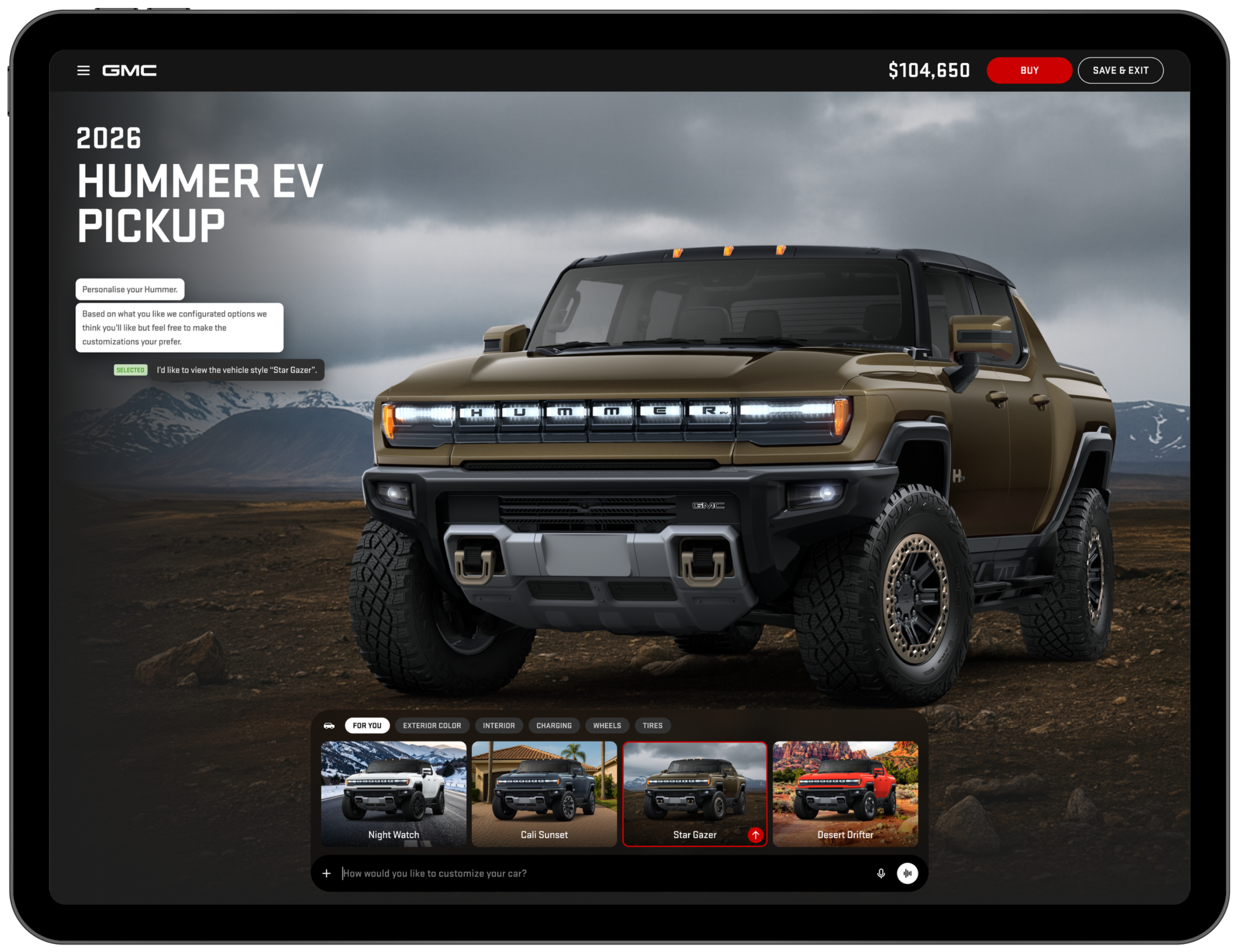
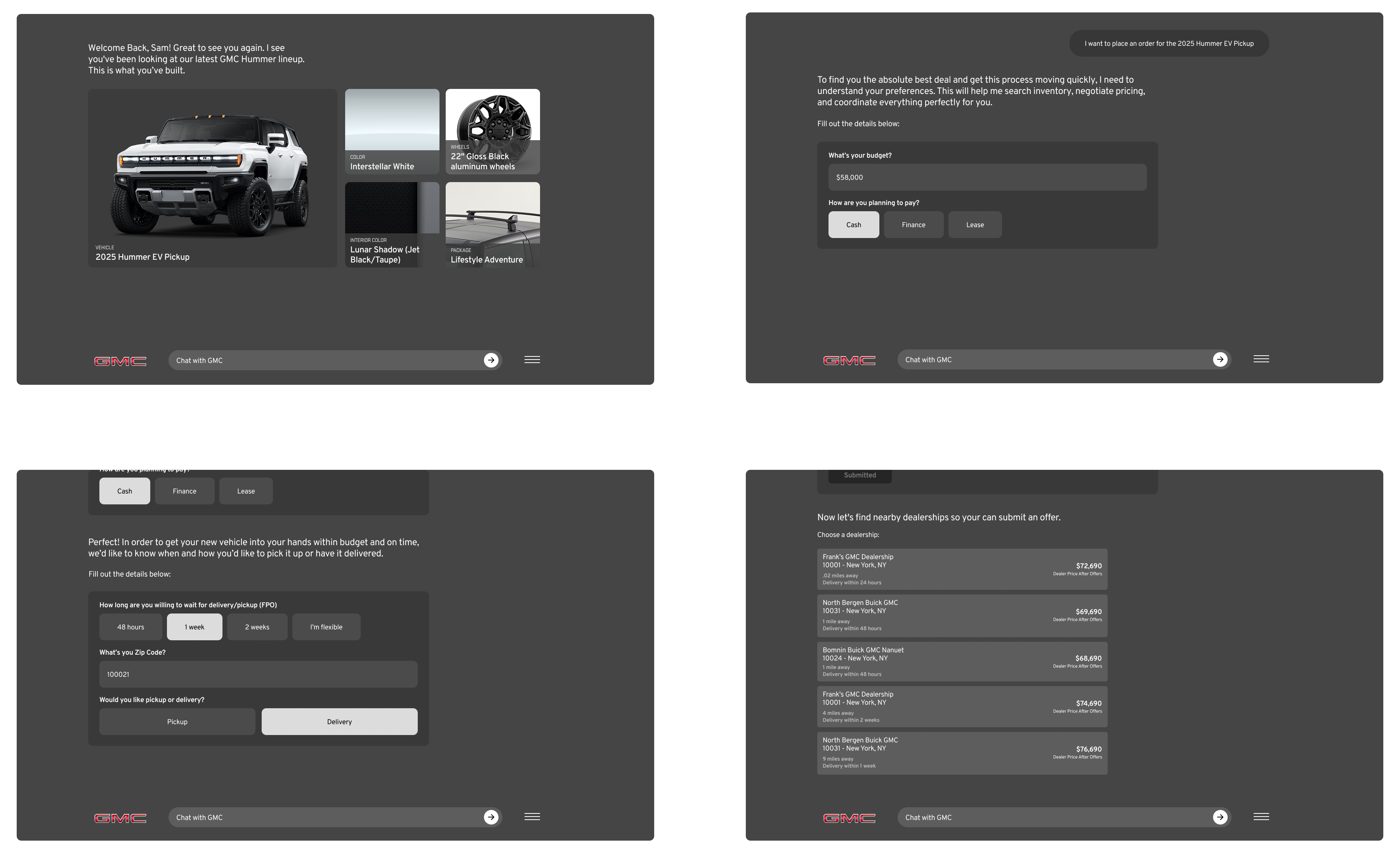
We reimagined the vehicle builder as a conversational, AI-assisted experience.
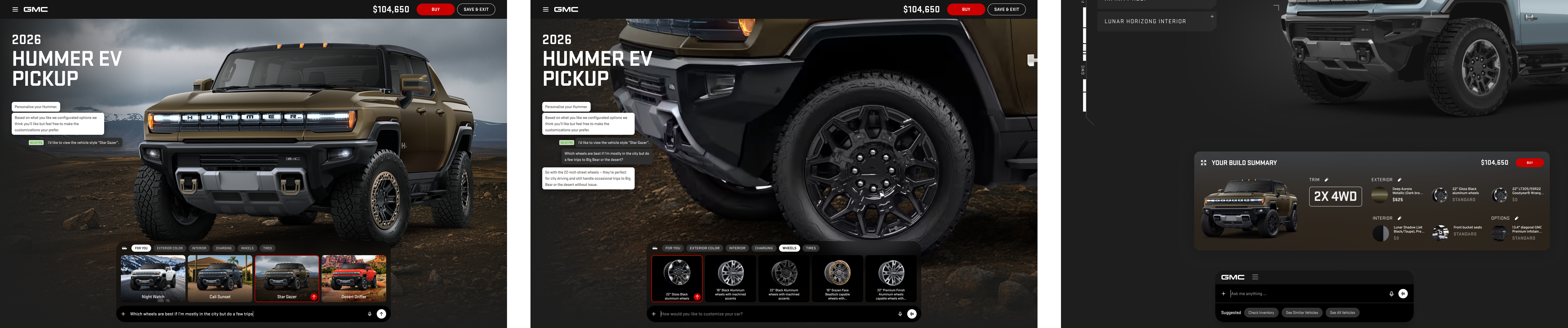
Instead of relying on checkboxes and traditional form inputs, the vehicle updated dynamically in response to user selections. As users adjusted wheels, colors, or trims, they saw changes reflected instantly. The AI layer allowed users to ask contextual questions — for example, about differences between wheel options or how certain features impact performance.
This shifted the experience from “filling out a form” to having a guided conversation.
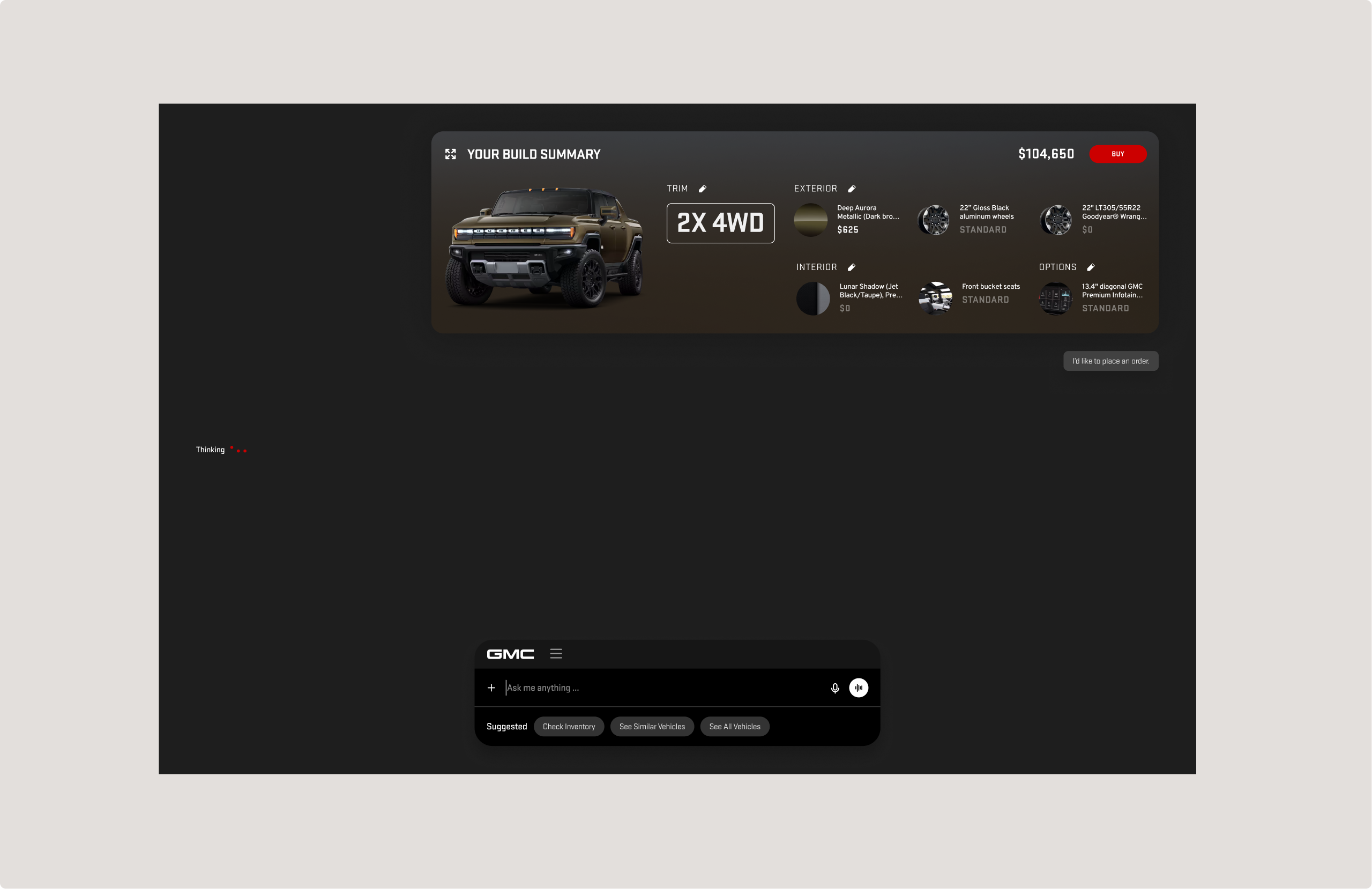
We also removed unnecessary distractions. Competing calls-to-action and unclear pathways were eliminated to create a focused, step-by-step progression. The goal was to reduce cognitive overload and make the journey feel intentional.
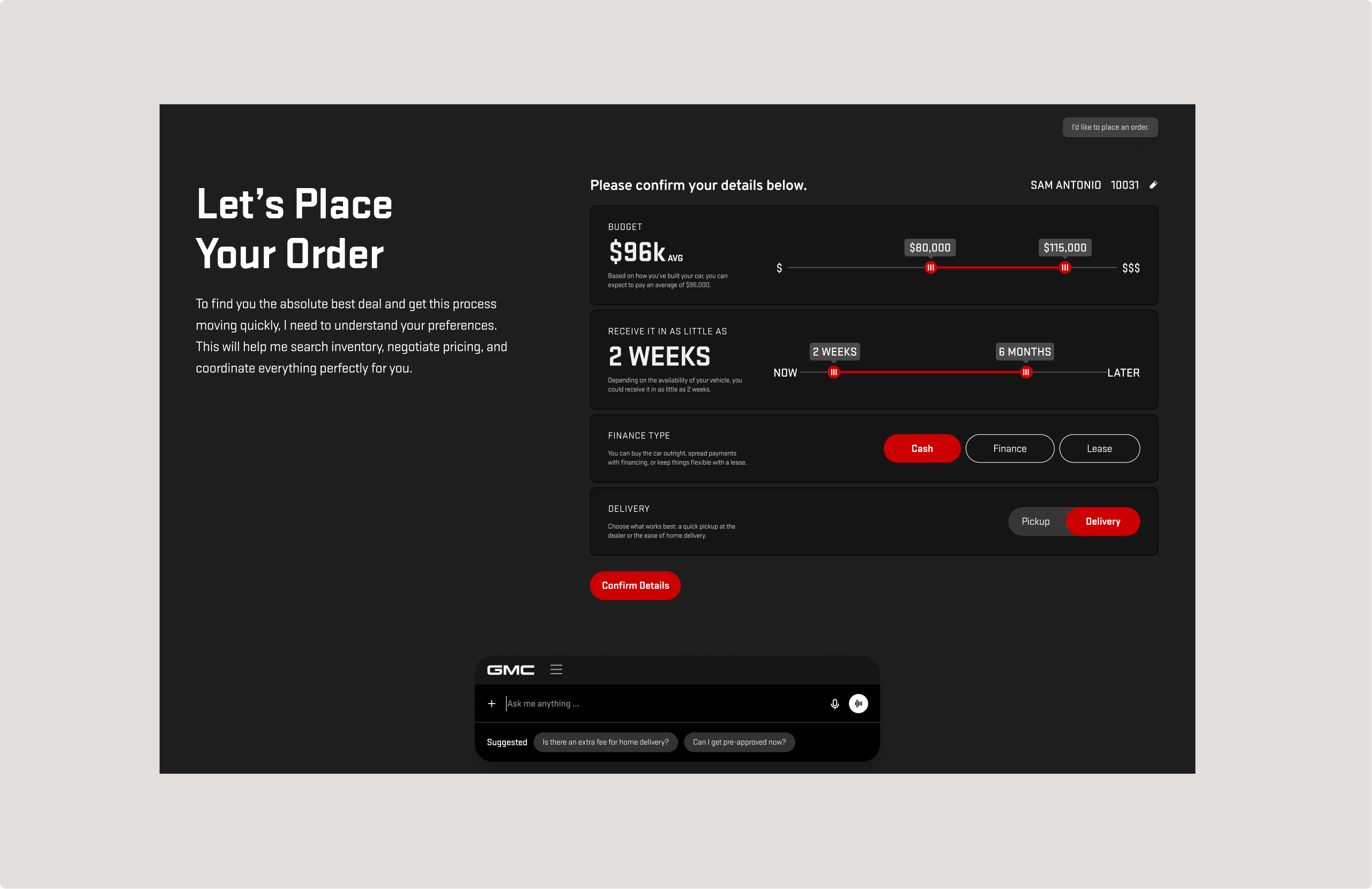
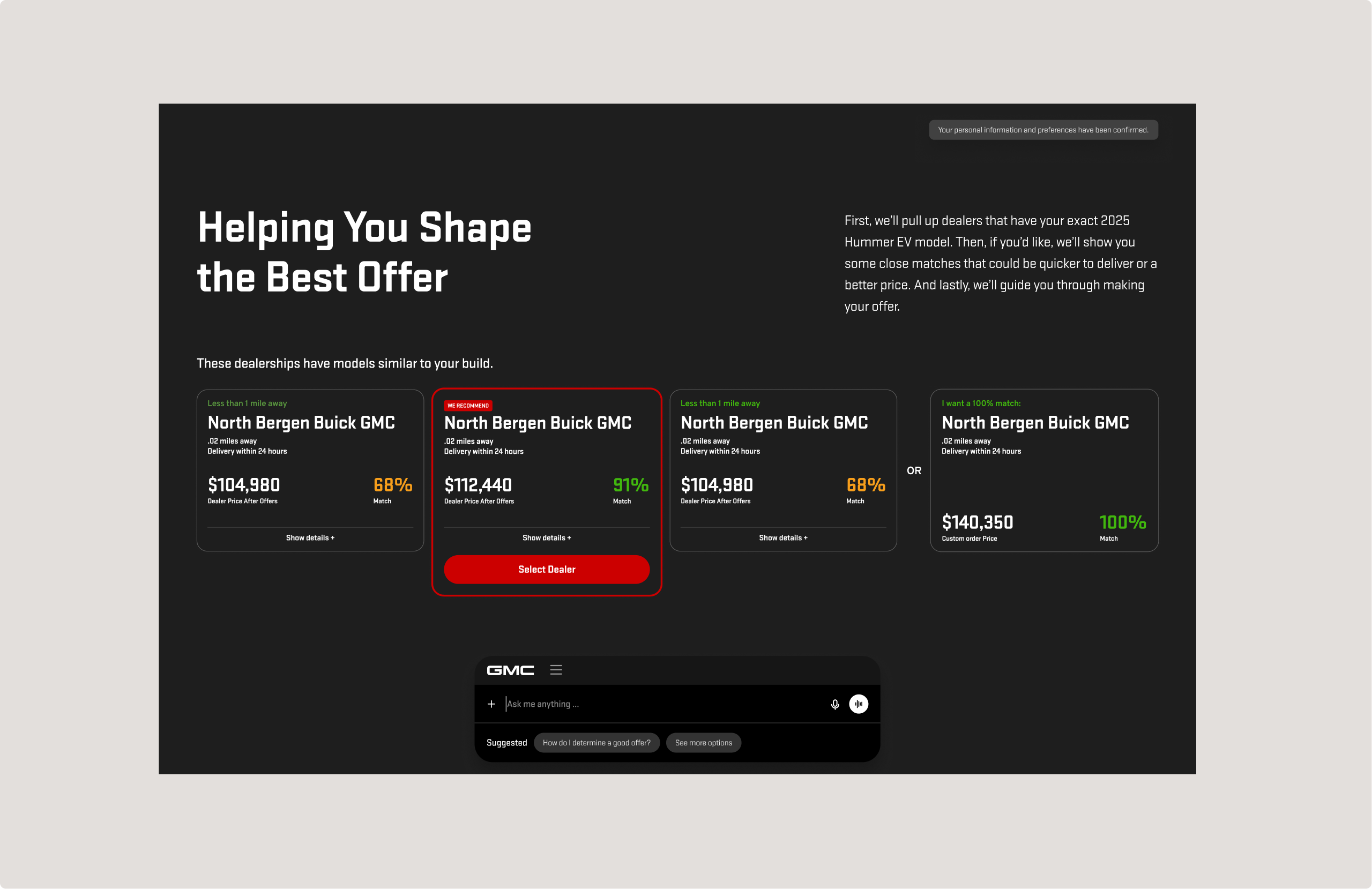
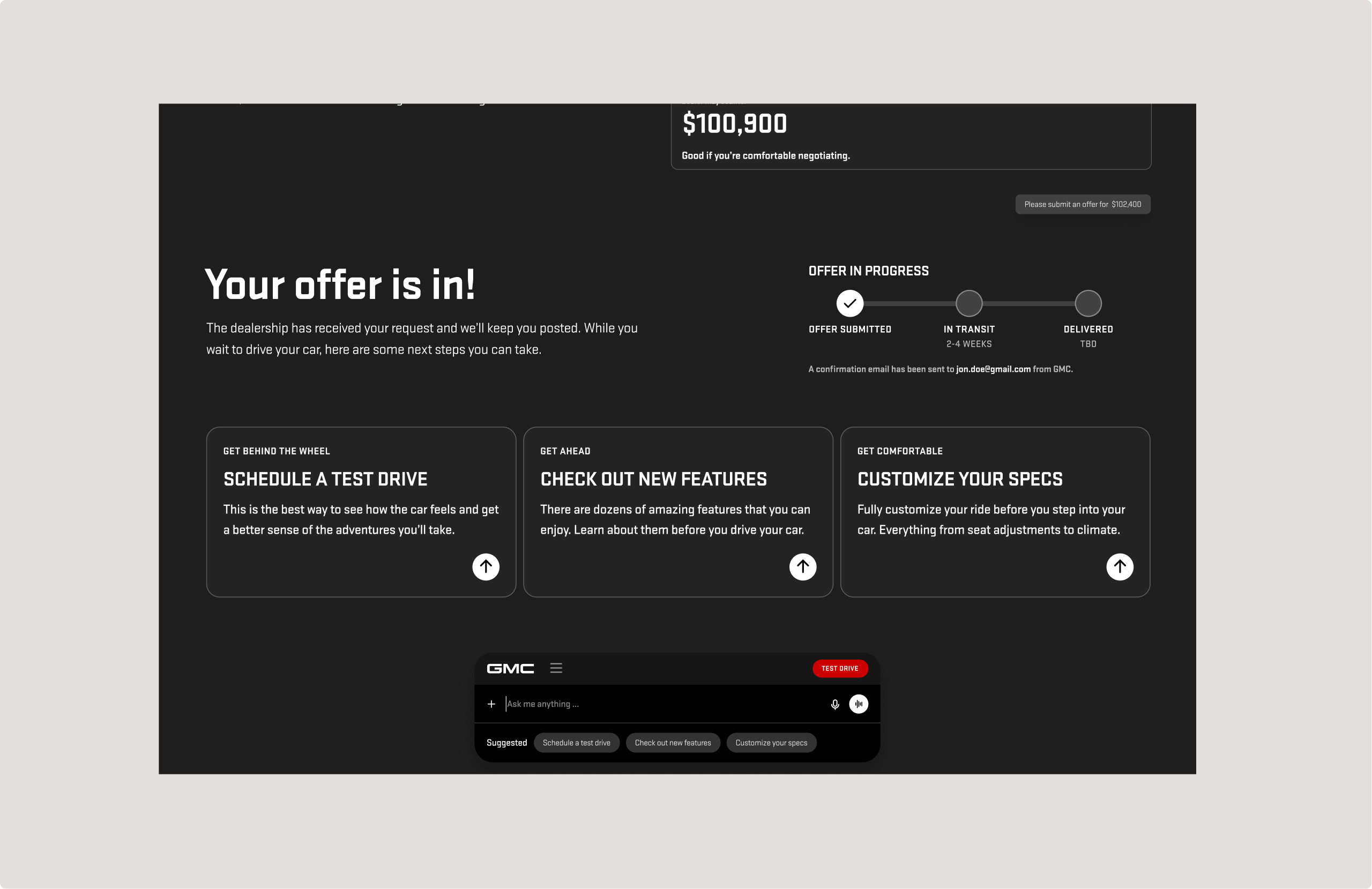
Challenge:
The existing builder experience contained competing calls-to-action, unclear progression, and cognitive overload.
Solution:
We removed distractions and restructured the flow into a guided, conversational progression, making the next step obvious and reducing user decision fatigue.
Challenge:
The vision required forward-thinking interaction patterns while still supporting real dealership workflows.
Solution:
We designed the AI layer as a guided assistant rather than a novelty feature, ensuring it supported inventory matching, financing options, and dealership handoff in a realistic and scalable way.
Kiesha Allen
Senior Product Designer
Interview me
GMC
Reimagining the Car Buying Journey Through A.I.
Goals
As part of the broader GMC AI-forward website redesign, our team explored what the vehicle customization and purchase journey could look like in an agentic, AI-integrated world. In this three-week sprint, we reimagined how users would move from researching a vehicle to customizing and placing an order — shifting the experience from a traditional configurator to a guided, conversational journey.
This case study focuses specifically on the customization and purchase flow.
Context
The existing GMC website contained a traditional vehicle builder and dealer handoff experience. However, the flow felt fragmented and overwhelming, especially for first-time buyers. Pages were filled with competing calls-to-action, unclear next steps, and a heavy reliance on checkboxes and dropdowns.
The challenge was to rethink customization and purchase in a way that felt immersive, clear, and future-ready — without losing practicality.
Research & Analysis
While I did not lead formal research, we conducted a full audit of the existing customization and purchase flow and reviewed competitive experiences.
The audit revealed several issues:
- Overwhelming interface with too many competing CTAs
- Unclear progression from customization to next steps
- A disconnect between building a vehicle and actually purchasing it
- Heavy reliance on static forms and checkbox-driven interactions
We also looked at brands like Rivian for immersive storytelling and Amazon’s Slate truck experience for interactive product exploration. These examples reinforced the importance of visual immersion and guided interaction rather than static configuration tools.
What We DEsigned and why
We reimagined the vehicle builder as a conversational, AI-assisted experience.
Instead of relying on checkboxes and traditional form inputs, the vehicle updated dynamically in response to user selections. As users adjusted wheels, colors, or trims, they saw changes reflected instantly. The AI layer allowed users to ask contextual questions — for example, about differences between wheel options or how certain features impact performance.
This shifted the experience from “filling out a form” to having a guided conversation.
We also removed unnecessary distractions. Competing calls-to-action and unclear pathways were eliminated to create a focused, step-by-step progression. The goal was to reduce cognitive overload and make the journey feel intentional.
Challenges
Solutions
The existing builder experience contained competing calls-to-action, unclear progression, and cognitive overload.

We removed distractions and restructured the flow into a guided, conversational progression, making the next step obvious and reducing user decision fatigue.
The vision required forward-thinking interaction patterns while still supporting real dealership workflows.
We designed the AI layer as a guided assistant rather than a novelty feature, ensuring it supported inventory matching, financing options, and dealership handoff in a realistic and scalable way.
Kiesha Allen
Senior Product Designer
Interview me
GMC
Reimagining the Car Buying Journey Through A.I.
Goals
As part of the broader GMC AI-forward website redesign, our team explored what the vehicle customization and purchase journey could look like in an agentic, AI-integrated world. In this three-week sprint, we reimagined how users would move from researching a vehicle to customizing and placing an order — shifting the experience from a traditional configurator to a guided, conversational journey.
This case study focuses specifically on the customization and purchase flow.
Context
The existing GMC website contained a traditional vehicle builder and dealer handoff experience. However, the flow felt fragmented and overwhelming, especially for first-time buyers. Pages were filled with competing calls-to-action, unclear next steps, and a heavy reliance on checkboxes and dropdowns.
The challenge was to rethink customization and purchase in a way that felt immersive, clear, and future-ready — without losing practicality.
Research & Analysis
While I did not lead formal research, we conducted a full audit of the existing customization and purchase flow and reviewed competitive experiences.
The audit revealed several issues:
- Overwhelming interface with too many competing CTAs
- Unclear progression from customization to next steps
- A disconnect between building a vehicle and actually purchasing it
- Heavy reliance on static forms and checkbox-driven interactions
We also looked at brands like Rivian for immersive storytelling and Amazon’s Slate truck experience for interactive product exploration. These examples reinforced the importance of visual immersion and guided interaction rather than static configuration tools.
What We DEsigned and why
We reimagined the vehicle builder as a conversational, AI-assisted experience.
Instead of relying on checkboxes and traditional form inputs, the vehicle updated dynamically in response to user selections. As users adjusted wheels, colors, or trims, they saw changes reflected instantly. The AI layer allowed users to ask contextual questions — for example, about differences between wheel options or how certain features impact performance.
This shifted the experience from “filling out a form” to having a guided conversation.
We also removed unnecessary distractions. Competing calls-to-action and unclear pathways were eliminated to create a focused, step-by-step progression. The goal was to reduce cognitive overload and make the journey feel intentional.
The layout prioritized clarity. The selected vehicle and matched dealership were given visual prominence, with supporting information structured in a secondary card rather than scattered across the page. This shift reduced cognitive overload and made the next step obvious.
The result was a cleaner, more focused interface that emphasized the user’s chosen vehicle instead of burying it among competing information.
Stakeholders responded strongly to the clarity and prominence of the selected vehicle within the layout. The concept successfully won internal approval, and Buick was chosen as the first brand to move forward with fully fleshing out the AI-driven purchase vision beginning in 2026.
Challenges
Solutions
The existing builder experience contained competing calls-to-action, unclear progression, and cognitive overload.

We removed distractions and restructured the flow into a guided, conversational progression, making the next step obvious and reducing user decision fatigue.
The vision required forward-thinking interaction patterns while still supporting real dealership workflows.
We designed the AI layer as a guided assistant rather than a novelty feature, ensuring it supported inventory matching, financing options, and dealership handoff in a realistic and scalable way.